
How this Research was Carried out
The research began as a result of internal conversations, but it was designed and conducted by external researchers. Insider access and a broad remit gave the study the opportunity to explore dynamics not often formally noted or considered together.
Five Questions
The study was structured around five questions, developed by the research team following consultations and feedback:
1

What are the currencies of influence within MSF?
2

Who holds these currencies, and how do they operate?
3

How do they interact with inequalities (in the organisation, the humanitarian sector,
and societies)?
4

What does MSF do to counteract these inequalities or perpetuate them?
5

What are the implications for the medical mission?
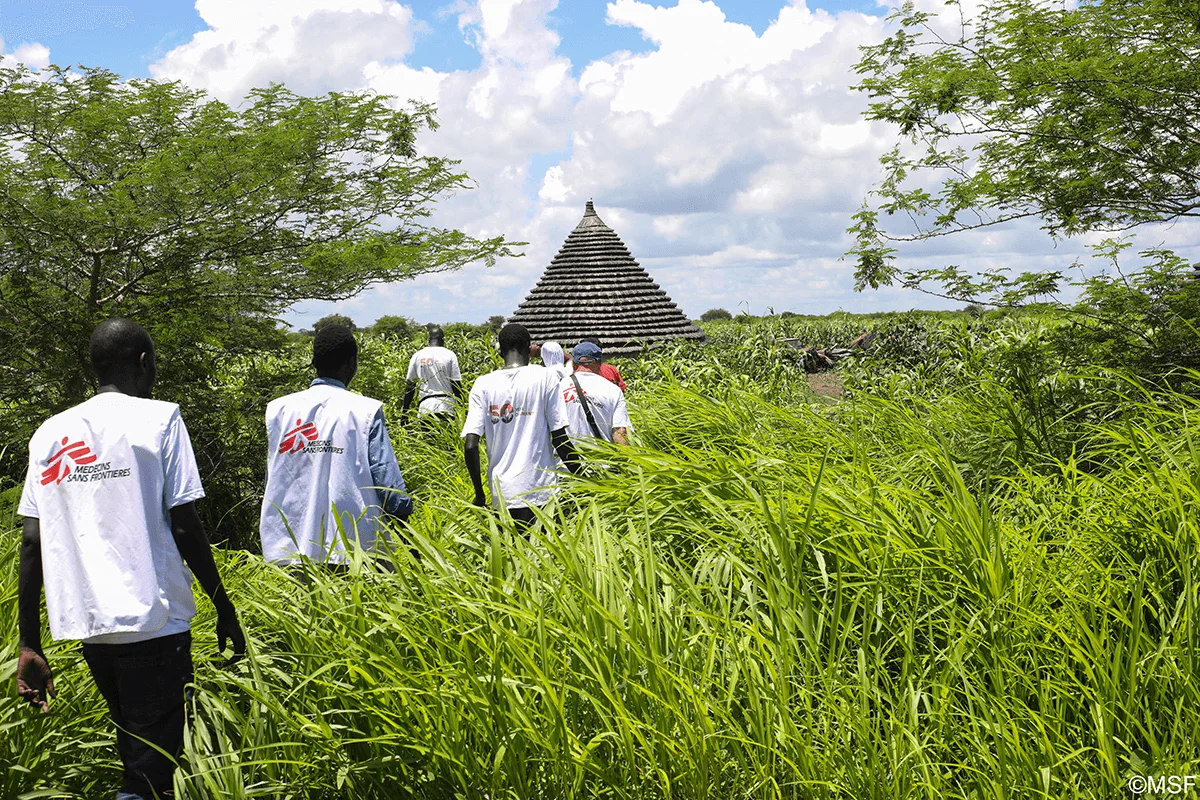
Researchers explored these questions using document analysis, focus groups, ethnographic observations and 147 in-depth interviews with current and former employees, as well as patients. These have all been kept anonymous and were conducted primarily with people working through the OCA and three case study project sites in eastern Democratic Republic of the Congo, North East Syria and South Sudan.
The researchers approached the five questions via four interlocking themes:
- Being and becoming MSF – opportunities, career progression and ideas of expertise in MSF.
- Care and protection – how MSF protects or cares for its own employees, and how this affects structures of inequality.
- Inclusion, change and participation – discussions and approaches to institutional culture, and who is able to speak within MSF.
- Doctor-patient dynamics – how power plays out during medical activities within MSF staff and between staff, patients and communities.
The research isn’t a complete account of how power plays out across MSF, and can only offer a partial view of a very complex issue with many aspects to it across its huge network of different Operational Centres, governance structures, coordination offices and project sites. However, the experiences and opinions represented in it vary enormously, and you may find yourself agreeing with some and not others.
A word from the research team
“Thank you for taking the time to engage with this research project. We hope that it offers insights into the workings of power within MSF and highlights the experiences of those MSF voices that are, for organisational, structural and functional reasons, often marginalised. As a contribution to critical reflection about the roles of humanitarian organisations and how they work, this research may become a resource for those who wish to challenge power dynamics and inequalities – including members of the MSF movement, patients and the communities where MSF works.”
We would like to dedicate this research to Seán Healy, who supported this research from its beginnings. His sharp insights, generous counsel, and balanced views were invaluable, and will be sorely missed.
How to navigate these findings
For each chapter, there is a summary of its findings and a link to the full chapter. Those of you who wish to read the full research you can download as a PDF on the Contents page or Conclusions page.
Emergency Culture
Introduces the idea of MSF’s ‘emergency culture’, something that shapes MSF’s work and mindset. Not all of MSF’s work takes place in the urgent setting of an ‘emergency’ situation, but the emergency culture has a huge impact on MSF’s decision-making and prioritisation, and therefore on its employees and the power inequalities between them.
Currencies of Influence
Introduces the ways inequality runs through MSF. It then describes six attributes that tend to contribute to a person having influence in the organisation: time in ‘the field’, friends in high places, whiteness, English language skills, masculinity and medical expertise.
MSF Identity
What does it mean to ‘be MSF’? This chapter looks at how the MSF identity draws on certain assumptions about who is neutral, expert and competent. It shows how this reinforces power hierarchies in countries where MSF operates, as well as in the movement’s associative structure.
Filters & Circuit Breakers
Examines the power concentrated in coordination positions. It argues that, as intermediaries between headquarters and the majority of (locally recruited) staff, these posts filter information, opportunities and particular policies into practice. This form of power is strictly hierarchical but also highly individualised, with direct consequences for career progression, opportunities for participation and the handling of the safety, security and health of different staff.
Keeping the Flame
Looks at who and what are seen as ‘legitimate’ in MSF. It focuses on the spirit of volunteerism and closeness to ‘the field’, and the way these impact on opportunities to enter MSF and on internal dynamics. In doing so, it highlights one of the ways informal power is used: to define what subjects or activities are viewed as legitimate uses of resources.
Diagnostic Disconnect
Looks at some of the reasons staff give for why, in their eyes, MSF struggles to act on its stated ambitions to change power dynamics. It looks at understandings and beliefs that impact the space and motivation for action.
Conclusion
Reflects on efforts to make meaningful change, different ideas about how that could or should happen, and the combination of faith and dismay that appears to shape how employees in OCA and MSF relate to the organisation.
Delve deeper
Image credit:
2. Alice Gotheron/MSF
3. Isaac Buay/MSF
Chapter 2. Methodology
This chapter outlines the origins and approach of the study. It includes reflections on the study’s limitations and the positionalities of the researchers.
2.1 Origins of the project
At the end of 2020, several members of the research team were contacted by members of the Manson Unit (part of MSF UK) who invited us to take part in an MSF-funded and facilitated research project on the theme of ‘power inequality’ in the organisation. This occurred amid renewed calls for reform in the humanitarian sector. In MSF, a ‘Decolonise MSF’ group had formed, and an open letter that denounced MSF as institutionally racist and reinforcing white supremacy in its work was signed by over 1,000 current and former members of staff. In this context of renewed critical discussion, several members of the Manson Unit and their networks envisaged an externally led, but MSF facilitated, research project that could empirically examine the intricacies of how power inequalities broadly, not racism or coloniality specifically, manifest in the organisation’s everyday work. The hope was that the project could eventually provide a resource for initiatives that seek to make power and inequalities more transparent, and which could also spark critical reflection within Operational Centre Amsterdam.
The research project was conceived as a ‘non-typical consultancy’. It was commissioned by the Manson Unit and attached to their social science research team: researchers external to MSF were not self-appointed but invited to participate on an existing research theme proposed by MSF. Yet there were no Terms of Reference. While members of the Manson Unit had written a research brief, it remained vague. Instead, we were invited to lead the project with editorial and analytical independence. Rather than following a template with specific objectives and recommendations, we were encouraged to conduct an inductive piece of academic research. That is, the research was shaped by the emerging themes and topics discussed during early consultations and by the participants. Despite this analytical freedom, the study was not a wholly external and independent project. The research team, although external to MSF, was guided by an advisory group made up of members of OCA, OCP, and MSF International. Staff members from the Manson Unit managed the composition of the advisory group. This group provided feedback to the research team during the course of the project, and helped with facilitating access to different networks in the organisation and field sites. They also advised on promoting engagement with the finished study, a process led by the Manson Unit.
In 2021, three members of the team, Lioba Hirsch, Eleanor Davey and Myfanwy James, agreed to participate in the research project on a part-time basis – averaging 1 day a week each – alongside their existing professional commitments. We were approached because of our relevant past research, which was already known to networks inside MSF. Davey’s research explores histories of aid and activism, and how historical perspectives can inform current debates. She has written about the way ideas about responsibility for the suffering of others shaped political and humanitarian engagements in France, including the creation of MSF. Hirsch examines colonial and anti-black entanglements of Western biomedicine and global health management. Her work has focused on the British-led international Ebola response in Sierra Leone in the wake of British colonialism and the transatlantic slave trade, and she led a project examining the colonial history of the London School of Hygiene and Tropical Medicine. James’ work examines the politics of humanitarianism and social identity in violent conflict. Her past research considered the experience of Congolese MSF employees and politics of identity when negotiating humanitarian access in eastern Democratic Republic of the Congo (DRC), as well as the debates surrounding an Ebola vaccine trial in DRC led by MSF.
The team spent a significant period of time considering how to approach a topic as broad as ‘power inequality’ in a movement as vast as MSF, even with the focus on OCA. The team had conversations with members of OCA, the Manson Unit, and other MSF sections aiming to delimit the themes and remit of the project. While the research team had existing expertise in inequality and discrimination in humanitarianism and global health, it became apparent that an additional focus on the power dynamics inherent in the medical work of the organisation would be beneficial. In December 2021, Molly Naisanga was invited to join the team and focus explicitly on patient-healthcare worker power dynamics. Naisanga is a psychiatrist based at the University of Gulu, Uganda, who has conducted qualitative research in medical settings. As well as this clinical background, Naisanga brings to the analysis the grounded experience of living and working as a medical professional in the Global South.
2.2 Methodology approach
Research Questions and Themes
The research examined how different forms of power affect the way MSF operates, focusing on OCA, both in terms of operational decision-making and in daily human relations. It considered how inequalities are perpetuated by, and within, MSF OCA. Recognising that the humanitarian sector is shaped by legacies of colonialism, the study sought to shed light on how these legacies may remain part of everyday humanitarian practices and discourses.
The study was structured by five research questions, developed by the research team following consultations and feedback:
- What are the currencies of influence within MSF?
- Who holds these currencies, and how do they operate?
- How do they interact with inequalities (in the organisation, the humanitarian sector, and societies)?
- What does MSF do to counteract these inequalities or perpetuate them?
- What are the implications for the medical mission?
We focused on four interlocking themes. Each theme was led by a different member of the research team, although data collection, analysis and writing were conducted collaboratively:
Being and becoming MSF, Myfanwy James
The first theme examined opportunities, career progression, and ideas of ‘expertise’ in MSF. It sought to understand who is considered to embody the MSF identity and principles, and how this interacts with imaginaries of neutrality, authority, and expertise. It considered different stages of a career path within MSF: training, opportunities for detachment and expatriation, and ‘nationalisation’ (appointing locally recruited staff to positions previously held by internationally mobile staff) of coordination positions. Throughout these different stages, the theme covered notions of ‘expertise’, and how they shape progression through the organisation. What kinds of knowledge are valued in the organisation and why?
Care and protection, Lioba Hirsch
The second theme examined how MSF protects or cares for its own employees, and how this interacts with and reinforces structures of inequality. It asked how ‘care’ is conceptualised in MSF, and what provisions are made for staff welfare before, during, and after an assignment. In addition, it examined the security infrastructures and protocols established during MSF’s work and asked how these perpetuate existing inequalities between staff.
Inclusion, change and participation, Eleanor Davey
The third theme examined discussions and approaches to institutional culture, and who is able to speak within the organisation. It looked at how power dynamics shaped participation in different forums, notably the spaces for associative life in the movement. It also considered how ‘diversity, equity and inclusion’ (DEI) are understood and how this understanding reflects and shapes different contexts, attitudes, or practical possibilities.
Healthcare provider-patient dynamics, Molly Naisanga
The fourth theme examined how power dynamics manifest in the course of medical activities within MSF staff and at the staff – patient/community interface. Aspects of the healthcare giving and receiving process in the context of MSF were looked at, including: decision making (at both macro and micro level); the approach to the actual practice of clinical care; and the positioning of patients and communities.
These four themes act as threads throughout the research, and were central to guiding our interview questions and discussions.
Multiple MSFs: Scale and focus sites
Based on these key themes, the research aims to capture broad dynamics of power inequality in the structure of OCA and to some extent the wider MSF movement, while also illustrating with empirical specificity the precise power structures that play out in particular project sites at particular moments. By weaving together interviews and relevant literature, we describe how power inequalities operate: at ‘headquarters’ (primarily in Amsterdam); in associative governance structures; in specific project sites; and in the whole MSF structure.
The research is not an exhaustive account of how power operates throughout MSF because MSF is far from a homogenous entity. The study concentrates on OCA but even this one centre comprises multiple MSFs. Today, the movement is a vast network of different Operational Centres, governance structures, coordination offices, and project sites. Individuals’ experiences of MSF vary enormously, and the way that the movement and organisational structures operate differs across time and place. So we describe the experiences within multiple MSFs, which co-exist. Not all MSF OCA projects, offices, and structures are the same, nor are the experiences of different staff and patients. The way that inequalities manifest in MSF, and interact with existing societal inequalities, is temporally and geographically situated.
To capture some of the specificities that illustrate our broader analytical points, the study used three OCA case studies:
- North and South Kivu, eastern Democratic Republic of the Congo: DRC is host to a large and long-standing OCA programme entailing primary and secondary care. In North Kivu, OCA has projects in Mweso, Walikale and Goma; it operates the South Kivu Emergency Response Unit from a base in Bukavu, as well as ‘vertical activities’, currently focused on treating malaria. With MSF first present in DRC in 1977, Congolese staff and communities’ contact with the movement has deep roots. The movement’s combined activities in DRC are among its largest country programmes by expenditure and number of staff, reaching €95 million and 2,650 full-time equivalent positions in 2021 (MSF International, 2022a, p. 12).
- North East Syria: OCA’s programmes in North East Syria were until recently managed by the Emergency Desk, shifting from addressing acute needs towards more chronic health and humanitarian interventions. From early 2011 when the Syrian war started, MSF was not able to be present in the country but since 2016 has established access to North East Syria via Iraq. It has projects in cities within the Autonomous Administration of North and East Syria and in detention settings in the region (such as in Al Hol camp and annex; see MSF International 2022b).
- South Sudan: Providing primary and secondary healthcare, OCA has multiple project sites in South Sudan (including Lankien, where it has been present for 28 years), a base in Loki-Choggio and a coordination office in Juba. During the period of the study, OCA was also managing emergency projects to respond to people affected by flooding and seeking to further increase its collaboration with the country’s Ministry of Health. The country constituted the largest nationality group among MSF staff in 2021, with 3,754 South Sudanese employees across the movement (Cragg and Linna, 2022, p. 36); at time of writing, OCA had approximately 1,300 locally recruited South Sudanese employees.
In selecting these case studies, our aim was to span a variety of different continents and regional settings where OCA works. However, this case selection was also shaped by the logistical practicalities and availability of MSF teams and their interest in participating in the project. Another case study, which would have facilitated research on OCA’s public-facing voice, including practices and ideas of témoignage and advocacy, fell through. By the time this happened, discussions had already drawn attention to the value of expanding the focus on internal participation.
Methods
The research is based on document analysis, in-depth interviews, focus groups and ethnographic observations.
Documents
The research draws on analysis of a range of internal MSF documents. We reviewed internal and external reports; policy documents related to areas such as security protocols, human resources, training, and communications, as well as operational updates and minutes or recordings of different kinds of meetings. To understand how inequality and discrimination have been debated within MSF, we also examined documents related to previous reform efforts, such as the La Mancha process. Articles, discussions and comments on Souk, MSF’s internal publishing platform, provided insight into contemporary sources of contention, as well as recent related initiatives. We did not access any medical or patient records.
Ultimately, these documents provide an insight into historical and contemporary debates around inequality and discrimination in MSF, and an insight into organisational procedures, policies and regulations. These documents were important in grasping particular organisational structures and discourses – especially those related to security, staff health plans, and human resources. Many of them have been used as background to inform our understanding and only some of them are directly cited in the text.
However, as with all archives, these documents bring into question the politics of institutional memory: they are products of recording and remembering, but also forgetting (Stoler, 2020, p. 23; Davey and Scriven, 2015). The OCA SharePoint was a bewildering experience for external researchers; while we could find many formal policy documents on the site, not only are documents laden with unelaborated acronyms, systematic searches are almost impossible. Many document sets have their own gatekeepers, who were in a position either to enable the research by facilitating access or to block it by denying access, delaying or restricting it, or simply not responding – however, it should be noted that most people were supportive. Yet documents do not capture the complexities of personal experience, nor the everyday debates and disagreements surrounding various policy decisions and organisational structures. Crucially, the voices of the majority of MSF’s employees – those who are ‘locally recruited’ – remain remarkably absent in the institutional archives, as do the perspectives of MSF’s patients. The institutional memory concerning the social relationships and complex hierarchies inherent in MSF’s work lies with personal histories, rather than archives. 26
Interviews
The research draws from 147 in-depth interviews with current and former MSF employees, as well as patients. During interviews with staff, our aim was to capture a range of different personal experiences of MSF’s work, from people who have occupied different posts within the organisational hierarchy and worked in different locations. Interviewees therefore included MSF staff from headquarters, coordination and project level. This included senior managers of OCA, internationally recruited employees in different countries, as well as a range of locally recruited staff in different regions (see box 2 on terminology); Ministry of Health staff were not included. The interviews lasted between one and two hours, and were semi-structured: we asked questions related to the research themes and questions. However, the interviews remained open ended, guided by each participant’s experience and comments.
The majority of interviews were conducted online, either on Microsoft Teams or WhatsApp. This facilitated the participation of MSF staff located all around the world. Document analysis helped identify potential participants. However, as the project progressed, participants were identified through snowball sampling. Given the broad range of different networks in OCA, we endeavoured to talk to a broad range of employees – including those with conflicting views.
Some interviews were also conducted in person during visits to eastern DRC, South Sudan, or in Paris and London. Each participant was sent an informed consent form and information sheet. Where consent was given, interviews were recorded and subsequently transcribed by an external transcription service. If consent was not given for us to record, we took detailed notes. Participants were given the choice whether to remain anonymous.
Interviews were conducted predominantly in English and French. When necessary, the help of translators was enlisted for interviews with staff in Syria, DRC and Uzbekistan, and with patients in South Sudan and DRC.
BOX 2: TERMINOLOGY
The terminology used within the MSF movement has evolved over time, in some cases due to intentional policy. One of the most important areas for this is the terminology used to describe staff groups according to contract type – a major category of analysis for human resources purposes but also a crucial axis of power inequality within the movement. The current, officially preferred language recognises two main types of ‘programme’ contracts, for ‘locally recruited’ staff and for ‘internationally mobile’ staff. These are distinguished from ‘headquarters’ staff; in some documents, headquarters staff are also described as ‘locally recruited’, so to avoid confusion the research does employ this usage. In addition to the officially preferred terms, however, interviewees and documents also used terms such as ‘national’, ‘local’, and (in French) ‘staff nat’; or ‘international’ and ‘expat’. Other terms have also been challenged for their colonial and/or military connotations, including terms such as ‘field’ and ‘mission’ which are “considered outdated by many staff” although they are still used within terms with specific meanings (such as Head of Mission, social mission) (Cragg and Linna, 2022, p. 14) as well as by some staff members. At different points in the research, we examine some of the implications of this terminology. Throughout the research, the terms used reflect interviewees’ speech and/or written practice.
Focus groups
The research also draws on seven focus group discussions held in person or on Microsoft Teams with MSF employees. The focus groups helped to facilitate discussion and debate from different perspectives and among people with different experiences. These discussions enabled us to gain an insight into not only how people narrate their own experiences, but also how they interact and debate with colleagues. Focus group discussions were recorded and transcribed by an external transcription service.
Fieldwork
Naisanga travelled to DRC in June 2022, and South Sudan in September 2022, to observe healthcare delivery and gain a better understanding of the existing work dynamics. These visits included being part of the project’s day-to-day life and being involved in research-relevant clinical activities such as attending routine briefing meetings within the teams and training sessions, and participating in ward rounds and patient consultations as an observer with no clinical involvement. Consent was sought from those present before these observations were initiated. These visits also allowed an opportunity for face-to-face interviews with both staff and patients at these project sites.
Ethics
The project was envisaged to run for one year during 2021. However, there were significant delays to beginning the research. The study went through an approval process with the OCA Research Committee (this was after and separate from the commissioning of the study). In 2021, we were granted access to MSF OCA SharePoint, and began documentary analysis while awaiting ethics approval. In January 2022, the MSF Ethics Review Board granted ethics approval and data collection began. Additional approvals were obtained from in-country ethics review boards in DRC and South Sudan.
2.3 Positionality
It is important to note that our own positions are inseparable from the relations of power that this research describes. ‘Studying up’, or the study of elite actors and institutions, is always relative and contextual – our own positionalities shape the nuances of ‘up’ in different contexts (Peters and Wendland 2016, p. 252). Two members of the team identify as white women from Europe and Australia, one as a Black woman of European and African origin, and another as a Black African woman. Three members of the team are based at or have affiliations with universities in high-income countries, and have built careers at institutions which have been similarly shaped by colonial histories of knowledge production. The diversity in our personal and professional backgrounds means we bring a mix of methodological and conceptual approaches to this study and this research contains a plurality of voices and analytical lenses. We do not always speak with one voice, nor have we sought to necessarily homogenise our analytical styles.
Nonetheless, as a research team, we possess many of the forms of influence and privilege highlighted in this research: a base in the Global North, an elite education, a medical degree, and/or an ability to work in English. When discussing the dominance of Anglophones in MSF OCA, the concentration of power in the Global North, or the pervasive power of whiteness and medical expertise, undoubtedly our own position influenced the research process, and clearly situated us in similar power structures. Our position was also complicated by our varied past experiences and interactions with MSF. While none of us have previously been employed by the organisation, two of us have conducted independent research on it. There was a degree of facilitation by MSF, as well as public dissemination activities to discuss our findings. This, along with the situation of several of our team in the European countries where MSF is headquartered, may have influenced how comfortable some employees felt in participating in the research and offering candid critique. However, we stressed to all participants that we would not share their identity or details of our conversations with anyone outside the research team. 30
For other members of MSF, our position in relation to existing internal reform initiatives remained ambiguous. Indeed, many potential participants asked how our research was different from current DEI initiatives, and the reaction to our research was often shaped by the internal politics surrounding existing reform processes. This is likely to have also shaped the sample of people we reached. One participant mentioned a conversation that captures some of these dynamics:
“Before my mate […] mentioned the power study, I had stumbled across it in SharePoint, and I was thinking, like, ‘Wow, this is really interesting, what they’re doing,’ and so I tried to talk to a few people about it and people are, like, ‘What’s the point? It’s just another pointless initiative that nothing’s going to change, because MSF is like this and it’s been like this for a long while’.”
Ultimately, we emphasised that our role was simply to understand better how power operated in the organisation. MSF is our object of study; our aim is to understand power structures in the organisation as academic researchers, rather than to identify how to somehow ‘solve’ these power inequalities as practitioners. Indeed, none of us have any experience working as humanitarians – this is not our skill set. In short, this research is not part of ongoing DEI initiatives. Instead, these DEI initiatives are part of our object of study as we trace how the organisation thinks about inequality, discrimination, and change.
2.4 Analysis
Rather than searching for a single ‘truth’ in a positivist sense, our research is rooted in the constructivist tradition of the social sciences. In short, this research is based on our interpretations of the various forms of data that we collected, and the deeply intersubjective meanings that formed during the process of data collection. Positionality is important because knowledge is always partial and situated: we can only ever understand something from a point of view (Haraway, 1988). The process of understanding is inevitably shaped by our own situated-ness (Gadamer, 1999, p. 296). Rather than triangulating the data, we sought crystallisation; we aimed to understand the topic from a range of different perspectives, which each provide a different viewpoint on the same phenomenon (Janesick, 2000). Over time, this provides a fuller picture.
After reading the transcripts, we aggregated common analytical themes which guide the chapters of this research. While the research was guided by an interest in the four research themes outlined, the analysis took the data obtained from documents and interviews, rather than those themes, as a basis. Therefore, instead of being structured according to the pre-determined research themes, the research is inductive and follows a logic that emerged from research participants and materials themselves.
2.5 Challenges and limitations
The subject of this research is daunting in scale: there is a myriad of ways that power manifests itself in the complex, transnational organisation of MSF in different project locations and across time. So this research project is not an exhaustive analysis of inequality in MSF’s work, but instead highlights several key points of analysis, based on conversations with a broad range of employees. This presented particular challenges. For example, during our conversations, it was difficult to separate OCA from the broader MSF movement. ‘MSF’ as an acronym acts as a catch-all – it was at times difficult to know which part of the organisation or movement people were imagining or referring to during our interviews.
Our analysis has inevitably been shaped by who was willing and available to talk to us, and who we were able to reach. The research process was itself shaped by the very same power structures that are the subject of study. The advantage of commissioning a team of researchers outside MSF was the idea that we would bring an external perspective and could be more attuned to the particularities of how power works within the organisation. On the other hand, this also meant that we had to rely on existing power and institutional structures in order to get access to documents, key stakeholders and permissions. In particular, the top-down nature of OCA’s management meant that contact with locally recruited personnel mostly had to pass through supervisors, HR Coordinators, Heads of Mission and Operations Managers. It was senior coordinators in each project and country, positions usually occupied by internationally mobile staff, who gave us the authorisation to begin contacting MSF staff. This made locally recruited staff less accessible and meant that identifying their voices was always going to prove more difficult than reaching headquarters staff. Field visits enabled us to address this limitation to a certain extent; further still we produced posters that were put up in project sites, and our emails introducing the research were forwarded to the personal email addresses of as many staff members as possible. The predominance of staff of European descent at headquarters and in senior roles in ‘the field’ also meant that they are overrepresented in this study and that they were often necessary for – or privy to – the researchers’ access to locally recruited staff. Hence, while this project explores power relations internal to OCA, its design and implementation are necessarily subject to those same relations.
This was compounded by challenges surrounding travel: during the course of this project, successive waves of Covid-19 hit at different times, and travel restrictions have ebbed and flowed. As a team based in different countries and conducting the project part-time, long-term fieldwork was not feasible. Instead, we aimed to talk to a range of different people during short visits and using online conference technology. Our aim was also to shift the focus away from ‘the field’ (which is central to the humanitarian imaginary), to ‘study up’ and to include organisational governance structures themselves. Despite the study being grounded in multiple sites, the lack of long-term fieldwork may influence its credibility in the eyes of an organisation that accords such weight to experience in ‘the field’ – a theme that is itself examined in this research.
Staff: The terms staff and employee are used to describe all employees who are both internationally mobile and locally recruited.